
Should you buy a MacBook Pro now?
Apple has launched an M6 MacBook Pro alongside a new touchscreen MacBook Pro equipped with M5 Pro and M5 Max chips. If you are purchasing your first MacBook Pro or replacing an older computer, evaluating your options is timely, although independent reviews should be consulted before making a final commitment. Owners of an M4 or M5 MacBook Pro that already fulfills daily requirements have minimal incentive to upgrade unless the OLED touchscreen technology and reduced weight of the new models offer a compelling advantage. Apple raised MacBook Pro pricing by $300 to $500 in June 2026, making discounts and refurbished units worth examining. For optimal financial value, compare non-touch M5 Pro and M5 Max options alongside remaining discounted M5 inventory against the latest releases. If the purchase is not urgent, waiting for Black Friday promotions toward the end of November is recommended.
The MacBook Pro targets creative professionals, software developers, engineers, and power users who require sustained performance, a high-end display, extensive ports, and elevated memory configurations. For workloads centered on web browsing, office productivity, academic study, or light creative tasks, the MacBook Air generally delivers superior value at a substantially lower price point. This guide assists buyers in selecting the appropriate MacBook Pro, outlines optimal purchase timing, highlights current deals, and contrasts these machines with refurbished alternatives and the MacBook Air.
Should you buy a MacBook Pro now?
With Apple’s newest MacBook Pros announced, buyers do not need to wait for availability to assess their options, as the M6 and touchscreen variants arrive on November 6. Independent reviews are recommended for anyone considering these releases. For immediate laptop needs, existing non-touch M5 Pro or M5 Max models remain practical purchases.
Purchasing a MacBook Pro now is advisable under specific conditions:
- Upgrading from an Intel Mac: Apple is phasing out support for Intel-based computers, meaning those who have not transitioned to Apple Silicon will lose security updates as support ends, leaving systems vulnerable to newly discovered threats.
- Needing a new laptop: Users experiencing broken, unreliable, or sluggish current Mac hardware have little reason to postpone replacement.
- Video editing and content creation: Individuals editing 4K video, working in Photoshop or Lightroom, producing music, or generating 3D graphics benefit from the sustained performance delivered by the MacBook Pro.
- Software development, engineering, or AI work: Compiling code, operating virtual machines, running artificial intelligence models, or analyzing large datasets executes significantly faster on MacBook Pro hardware, particularly M5 Pro and M5 Max configurations.
- Sustained performance requirements: Unlike fanless alternatives, the MacBook Pro utilizes active cooling to sustain peak processing speeds during extended exports, renders, and demanding computational tasks.
- Professional features: The lineup provides Liquid Retina XDR or PROLED XDR displays featuring ProMotion, HDMI, an SDXC card slot, MagSafe charging, and expanded memory and storage limits compared to the MacBook Air.
- Securing an excellent deal: Discounted hardware can represent a strong purchase if specifications align with user needs. Memory, storage, display, and processor metrics should be compared against newer releases to determine if the price reduction justifies the investment.
When shouldn’t you buy a MacBook Pro?
While the MacBook Pro is a capable system, it does not suit every user. Those who do not require elevated performance or professional hardware features save money and find equal satisfaction using a MacBook Air. Certain circumstances also warrant delaying a purchase rather than buying immediately.
Purchasing a MacBook Pro should be avoided under the following circumstances:
- Seeking a processor upgrade beyond M5 Pro or M5 Max: Touchscreen variants maintain identical chip options to non-touch equivalents, with M6 Pro or M6 Max processors anticipated for release in 2027.
- Chasing optimal pricing: The introduction of M6 models may render discounts on discontinued M5 MacBook Pro inventory more appealing, while Black Friday could yield further price cuts.
- Relying on everyday tasks: Workloads limited to web browsing, Microsoft Office, media streaming, email, video calls, or basic photo editing run effectively on a MacBook Air at a lower cost.
- Basic student computing needs: Coursework focused on essay writing, online research, or presentations is handled efficiently by a MacBook Air.
- Portability as a primary priority: The MacBook Air provides a thinner, lighter, and entirely silent fanless build, although the touchscreen MacBook Pro is lighter than its non-touch counterpart.
- Operating on a strict budget: The MacBook Air delivers robust performance for most users at a significantly lower cost than the Pro lineup.
For most users, the MacBook Air represents the better purchase. The MacBook Pro becomes necessary only when workloads regularly demand active cooling, more powerful processors, advanced displays, additional connectivity ports, and higher memory configurations.
Should I buy a MacBook Pro: At a glance
| Your situation | Our recommendation |
|---|---|
| Intel Mac or an older Mac that struggles with work | Consider upgrading; choose the configuration around the workload |
| M1, M2 or M3 MacBook Pro | Upgrade if performance, memory, battery or display is limiting you |
| M4/M5 model working well | Keep it unless the new screen and design solve a specific need |
| Want OLED and touch | Compare PROLED XDR models; read reviews before committing |
| Need Pro/Max performance without touch | Compare the non-touch range |
| Want the lowest price | Compare clearance, refurbished and Black Friday offers |
| Mainly everyday computing | Consider Air or Neo before paying for a Pro |
MacBook Pro: Current line up
Apple’s MacBook Pro portfolio encompasses three core categories: the entry-level 14-inch M6, non-touchscreen M5 Pro and M5 Max models, and the updated M5 Pro and M5 Max configurations featuring PROLED XDR touchscreen displays. Retail inventory may also feature clearance stock of prior entry-level M5 MacBook Pro units.
MacBook Pro M6
Introduced in October 2026, the 14-inch M6 serves as the entry-level MacBook Pro option. Configurations begin with a 12-core CPU, 12-core GPU, 16GB of unified memory, and 1TB of storage. The chassis retains the design and non-touch Liquid Retina XDR display of previous iterations while integrating the M6 processor, Wi-Fi 7, and Bluetooth 6. This model suits buyers seeking Pro-tier displays, ports, and active cooling without purchasing an M5 Pro or M5 Max configuration, with pricing starting at $1,999/£1,999.
MacBook Pro M5 Pro & M5 Max
Launched in March 2026, these computers introduced Apple’s Fusion Architecture, merging two 3nm dies into a single system-on-chip. Key specifications include:
- M5 Pro: configurations up to an 18-core CPU comprising 6 super cores and 12 performance cores.
- M5 Max: configurations scaling up to a 40-core GPU, 128GB of RAM, and 8TB of storage.
- Thunderbolt 5, Wi-Fi 7, and Bluetooth 6 supported via Apple’s N1 wireless component.
- Battery life ratings reaching 22 hours for the 14-inch M5 Pro and 24 hours for 16-inch variants.
MacBook Pro with PROLED XDR Display
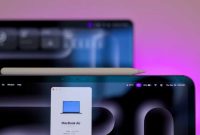
The touchscreen MacBook Pro commands a $400/£400 premium over equivalent non-touch M5 Pro or M5 Max models. This price difference incorporates a tandem OLED display, touchscreen capabilities, Dynamic Island functionality, and a thinner, lighter enclosure. Processor generations remain unchanged, retaining identical M5 Pro or M5 Max chip options and manufacturer battery life ratings. The hardware updates function primarily as a display and portability enhancement.
Additional costs are justifiable for users spending significant working hours interacting directly with the built-in screen, particularly in visual design contexts, or those frequently transporting the device. For setups permanently connected to an external monitor, non-touch versions provide better value. Evaluating independent assessments covering display performance, reflectivity, fingerprint resistance, touch controls, and software ecosystem compatibility is recommended before purchase.
Previous generation models
The 14-inch M5 MacBook Pro launched in October 2025 featuring a 10-core CPU, 10-core GPU, 16GB of unified memory, 1TB of storage, Thunderbolt 4 connectivity, and up to 24 hours of battery longevity. This prior iteration represents a viable purchase when substantial discounts apply relative to an equivalent M6 configuration. Memory and storage allocations require careful verification, as identical pricing makes the newer M6 the preferable starting point.
Is the touchscreen MacBook Pro worth $400/£400 more?
The price premium delivers OLED panel technology, touch input, reduced weight, and design refinements while maintaining identical M5 Pro and M5 Max processing options and advertised battery endurance. Workflows centered on external monitors diminish the utility of the upgrade, whereas professionals handling photography, video, or visual media derive greater benefit from the hardware enhancements. Reviewing independent testing regarding touch ergonomics, screen reflections, fingerprint accumulation, and software support prior to investing is advised.
What’s the best MacBook Pro price right now?
Apple rarely discounts computer hardware directly. In June 2026, Apple increased MacBook Pro pricing by $300 to $500, elevating the importance of shopping through third-party retailers. Price increases coincided with Amazon’s Prime Day event, during which M5 MacBook Pro units reached record-low pricing. Discounts lowered entry-level models to $1,499/£1,529, representing historical lows that remain unlikely to return outside of major retail events such as Prime Day or Black Friday.
Best U.S MacBook Pro deals
| MacBook Pro Configuration | Deal Status | New MSRP | Old MSRP | Lowest Recorded Price |
|---|---|---|---|---|
| 14-inch, M5, 1TB, 16GB | $160 off at Amazon | $1,999 | $1,699 | $1,499 |
| 14-inch, M5, 1TB, 24GB | $160 off at Amazon | $2,199 | $1,899 | $1,699 |
| 14-inch, M5 Pro, 1TB | $155 off at Amazon | $2,499 | $2,199 | $1,983.94 |
| 14-inch, M5 Max, 2TB | $600 off at Amazon | $4,099 | $3,599 | $3,299.99 |
| 16-inch, M5 Pro, 1TB | $250 off at Amazon | $2,999 | $2,699 | $2,449 |
| 16-inch, M5 Max, 2TB | $500 off at Amazon | $4,399 | $3,899 | $3,649 |
Best U.K. MacBook Pro deals
| MacBook Pro Configuration | Deal Status | New RRP | Old RRP | Lowest Recorded Price |
|---|---|---|---|---|
| 14-inch, M5, 1TB | Out of stock | £1,999 | £1,699 | £1,528.97 |
| 14-inch, M5 Pro, 1TB, 24GB | £249 off at Amazon | £2,499 | £2,199 | £1,978.97 |
| 14-inch, M5 Max, 2TB | £300 off at Amazon | £4,099 | £3,599 | £3,238.97 |
| 16-inch, M5 Pro, 1TB | £299 off at Amazon | £2,999 | £2,699 | £2,428.97 |
| 16-inch, M5 Max, 2TB | Available at Amazon | £4,399 | £3,899 | £3,508.97 |
When is the best time to buy a MacBook Pro?
The lowest pricing on MacBook Pro hardware occurs during major promotional periods such as Amazon Prime Day iterations in June, July, or October, alongside Black Friday events. Black Friday typically generates the highest volume of offers, though deep discounts often focus on older or clearance configurations where stock depletes rapidly. Black Friday 2026 promotions are anticipated to commence near the start of November.
Releases of new hardware generations also prompt retailers to discount previous-generation inventory to clear warehouse space, enabling savings of several hundred dollars for buyers who do not require the newest processors. Educational pricing remains available year-round; students, teachers, and school staff can secure $100 to $200 reductions via Apple’s Education Store. The most advantageous purchasing window occurs during annual summer Back to School promotions, which bundle hardware price cuts with complimentary accessories such as AirPods.
| Timing | Why it’s a good time | Typical saving |
|---|---|---|
| Amazon Prime Day (June/July/October) | Deep discounts from Amazon. | $150 – $800+ off MSRP |
| Black Friday / Cyber Monday (November/December) | The biggest sales event of the year for electronics. | $200 – $500+ off MSRP |
| After a New Model Launch (March/October) | Retailers discount the previous generation to clear inventory. | Varies; often $200–$400 off |
| Apple Refurbished Store (Year-Round) | “Like-new” condition with full warranty; pre-hike prices. | 15%–30% off original MSRP |
| Apple Education Store (Year-Round) | Direct discount for students and educators. | $100 – $200 off MSRP |
Is buying a refurbished MacBook Pro a good idea?
Purchasing refurbished hardware offers a reliable method for reducing costs, particularly when acquiring systems directly from Apple’s Certified Refurbished Store. Apple Certified Refurbished computers typically cost roughly 15% less than new alternatives and include a standard one-year warranty, 90 days of technical support, and eligibility for AppleCare+ coverage. Units undergo exhaustive testing, cleaning, inspection, and repair using genuine Apple replacement components.
Availability represents the primary limitation, as inventory fluctuates daily and requires patience to secure specific storage, memory, or color configurations. Newer MacBook Pro models generally appear in the refurbished channel several months post-launch. Third-party vendors also market refurbished hardware, though quality controls vary. Systems exceeding five years of age should generally be avoided to ensure extended macOS and security patch compatibility. Comparing refurbished pricing against clearance promotions for new, previous-generation hardware during sales events remains recommended.
Best refurbished MacBook Pro deal right now
Apple lists M5 MacBook Pro inventory within its U.S. Certified Refurbished store at approximately $300 below original retail pricing. Within the U.K. Certified Refurbished store, reductions reach up to £450 on M5 Pro MacBook Pro variants and up to £750 on 16-inch configurations equipped with M5 Max processors.
Which MacBook Pro to choose
Selecting the M6 MacBook Pro suits users desiring professional display attributes, expanded input ports, and active cooling without the computational capacity of M5 Pro or M5 Max silicon. The M5 Pro MacBook Pro addresses the requirements of professionals editing 4K video, compiling extensive software code, processing RAW photographs, producing music, or multitasking heavy applications, delivering optimal balance between price and performance for developers and creatives. The M5 Max MacBook Pro targets extreme workloads involving multiple streams of 8K video editing, complex 3D animation rendering, large-scale artificial intelligence execution, or GPU-intensive visual effects production.
Choosing an M5 Pro or M5 Max MacBook Pro featuring a PROLED XDR Display depends on whether the OLED touchscreen panel and reduced chassis weight justify the $400/£400 price increase. Performance tiers between Pro and Max processors should be determined by workload requirements independent of display choice.
What about the MacBook Air?
Apple updated the MacBook Air in March 2026 with starting prices at $1,299/£1,299 following June price adjustments, positioning the machine as a cost-effective alternative to the MacBook Pro. The MacBook Air accommodates users whose activities center on web browsing, Microsoft Office suite operation, media streaming, student coursework, and basic tasks valuing portability and fanless acoustic silence.
Hardware compromises include lower sustained performance limits, reduced display specifications, fewer connectivity ports, and lower maximum memory configurations compared to the MacBook Pro. The Pro lineup remains necessary for continuous workloads like video editing, software compilation, 3D rendering, or AI processing, alongside Advanced Liquid Retina XDR displays, ProMotion refresh rates, integrated HDMI, SDXC card slots, and elevated unified memory capacities up to 128GB.
Do you need to upgrade your current Mac?
Upgrade requirements depend on system age, active software support status, and performance consistency under daily workloads. Apple has terminated support for Intel-based Macs starting with macOS 27 Golden Gate. While limited security updates may persist for a short duration on machines supporting macOS 26 Tahoe, support cycles remain near termination.
The limited set of Intel Macs compatible with macOS Tahoe includes the 2019 16-inch MacBook Pro, 2020 13-inch MacBook Pro with four Thunderbolt ports, 2020 27-inch iMac, and 2019 Mac Pro. Systems excluded from this list forfeit upcoming macOS updates and eventual security patches. Transitioning from Intel architecture to Apple Silicon introduces substantial performance gains, extended battery longevity, silent operation, Apple Intelligence compatibility, and prolonged software lifespan.
Which are the best retailers to buy a MacBook from?
Beyond Apple’s direct sales channels, multiple authorized third-party resellers offer periodic discounts on MacBook Pro hardware. When purchasing through external retailers, verification of processor generations, RAM allocations, SSD capacities, architecture types (Intel versus Apple Silicon), and display panel specifications (Liquid Retina XDR versus PROLED XDR) is essential to prevent overpaying for legacy equipment without comparative evaluation.
U.S. buyers target Amazon, B&H Photo, Walmart, and Best Buy for competitive pricing. U.K. purchasers rely on Amazon, KRCS, John Lewis, Currys, and Laptops Direct.