
Look around your home or workplace and you will notice how many smart devices quietly run embedded software behind the scenes. From smart thermostats to fitness trackers, modern electronics depend on tightly integrated code that operates inside dedicated computer hardware. Most users never see it, yet it shapes how devices respond, react, and perform every second they are powered on.
This hidden layer has become more important as connected technology spreads rapidly. The growth of embedded software in IoT ecosystems means everyday objects now collect data, make decisions, and communicate without constant human input. A smart door lock, for example, does far more than open and close. It verifies identity, manages power usage, and syncs with mobile apps in real time.
Many beginners assume only large computers run complex programs. That idea no longer fits today’s devices. Small chips inside appliances now handle precise tasks with impressive efficiency. The code inside them is purpose-built, lightweight, and highly reliable.
What Is Embedded Software
Simple Definition
Embedded software is specialized code programmed to control a specific hardware device and perform dedicated functions within a larger electronic system.
In plain English, it is the brain that lives inside smart hardware. It tells the device what to do, when to do it, and how to respond to inputs from the real world. This type of software does not try to handle many unrelated tasks. It focuses on one job and performs it consistently.
According to Digi International, an embedded system is a specialized computing device designed to perform dedicated tasks within a larger system and typically integrates both hardware and software.
This description highlights an important point. The value comes from tight integration. The software is not floating independently like a desktop app. It is built specifically for the hardware it controls. That close relationship allows devices to run faster, consume less power, and behave predictably even in demanding environments.
For engineers, this specialization is the main reason such systems are widely used in modern electronics.
Where Embedded Software Fits in an Embedded System
Inside a typical embedded system, the software layer sits between the hardware components and the higher-level logic that defines device behavior. It communicates directly with microcontrollers, sensors, and actuators while translating physical signals into meaningful actions.
Firmware often operates at a lower level. It handles boot routines and basic hardware initialization stored in flash memory. Application software, on the other hand, usually runs on full Operating systems and interacts heavily with users. The embedded layer lives between these extremes.
Think of the microcontroller as the device’s heart. The dedicated control code acts as the nervous system that carries instructions throughout the product. Without it, sensors would collect data but nothing useful would happen.
This layered structure keeps systems efficient and easier to maintain over long product lifecycles.
Quick Real-World Analogy
Imagine a modern washing machine. The physical drum, valves, and motors form the hardware. The user panel acts like a simple interface. Hidden inside, a small control program decides water levels, spin timing, and safety checks.
That internal logic behaves like a quiet supervisor. It never asks for attention, yet every wash cycle depends on it running correctly. This is exactly how embedded software examples appear in many household devices.
Why Embedded Software Matters
Dedicated device control has become essential as electronics grow smaller and more capable. Embedded software ensures each product performs its specific role with precision. A medical infusion pump must deliver exact fluid amounts. An automotive control unit must react instantly to sensor input. General-purpose code would struggle to meet those strict demands.
Real-time performance is another major factor. Many devices cannot tolerate delays. They must respond within milliseconds to maintain safety and usability. Real-time embedded software is designed for deterministic timing, meaning responses happen within predictable windows.
Efficiency also plays a critical role. Most embedded hardware operates with limited memory and power budgets. Well-optimized code keeps energy consumption low while maintaining reliable performance. This balance is especially important in battery-powered IoT products that must run for months or years without maintenance.
Reliability pressure is often higher than in traditional computing. A frozen phone app is annoying. A failed industrial controller can halt production or create safety risks. Engineers therefore design these systems with extensive testing, watchdog timers, and fault handling routines.
According to Parasoft, embedded systems are microprocessor-based systems built into products with a dedicated operational role and tightly integrated hardware and software components.
This reinforces the central idea: tight integration drives performance and dependability. When hardware and software are designed as one unit, devices can meet strict timing, power, and reliability requirements that general computing platforms rarely achieve.
Core Functions of Embedded Software
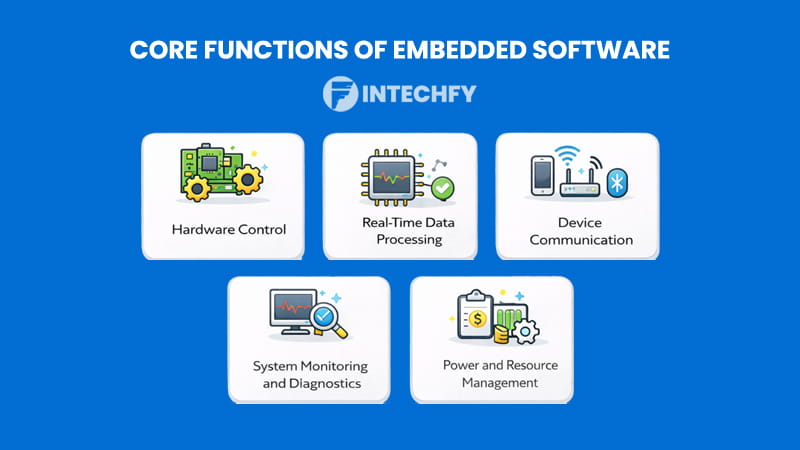
Modern electronic products rely on precise internal control to behave correctly in real-world conditions. At the center of that control sits embedded software, which acts as the decision-making layer inside dedicated hardware. Its responsibilities go far beyond simple command execution. It must react to inputs, manage limited resources, maintain timing accuracy, and keep the entire device stable over long operating periods.
Device-level code cannot tolerate delays or heavy resource waste. It must remain predictable at all times. Even a tiny timing slip can reduce performance or create safety risks. Engineers therefore design these systems with tightly defined functional roles that stay closely aligned with the underlying electronics.
Below are the core capabilities that allow these systems to operate reliably in everything from household appliances to industrial equipment.
Hardware Control
One of the primary responsibilities is direct control of physical components. The software communicates with sensors to collect data and with actuators to trigger real-world actions such as moving motors or switching relays.
Device drivers play a key role here. They translate high-level instructions into electrical signals the hardware can understand. This tight coordination ensures the product behaves exactly as designed, even when operating continuously for long periods.
Real-Time Data Processing
Many devices must react within strict time limits. Real-time embedded software handles this requirement by processing incoming data with deterministic timing, meaning responses occur within predictable windows.
Interrupt handling is often used to prioritize urgent events, such as a sudden sensor change. In more complex designs, a lightweight RTOS helps schedule tasks efficiently while maintaining timing guarantees. This approach keeps critical operations responsive even when multiple processes run simultaneously.
Device Communication
Modern products rarely operate in isolation. Device-level programs frequently manage wired or wireless communication using protocols such as UART, SPI, I2C, or TCP/IP. These interfaces allow products to exchange data with other systems or cloud services.
The rise of embedded software in IoT has made networking support especially important. Smart home devices, industrial sensors, and wearable technology all depend on reliable data exchange. Efficient communication handling ensures information moves quickly without overwhelming limited system resources.
System Monitoring and Diagnostics
Reliable devices must constantly check their own health. Built-in monitoring routines track temperature, memory usage, and operational status to detect abnormal behavior early.
Fault detection mechanisms help isolate problems before they escalate. Watchdog timers provide an additional safety layer by automatically resetting the system if normal execution stops. These safeguards are essential in products that must operate unattended for months or years.
Power and Resource Management
Most embedded platforms run with tight memory and energy budgets. Efficient resource management keeps the memory footprint small while preserving performance.
Power-saving techniques are equally important. Many systems use sleep states, clock scaling, or low-power modes to extend battery life. Careful optimization at the software level allows even small devices to deliver reliable performance without excessive energy consumption.
Key Characteristics of Embedded Software
Engineers design embedded software with a distinct set of priorities that separate it from general computing programs. These characteristics shape how the code is written, tested, and deployed inside real products.
Real-Time Constraints
Real-time behavior means the system must respond within defined time limits. Missing a deadline can lead to incorrect operation.
This matters most in safety-critical environments. For example, an automotive braking controller must react within milliseconds after detecting wheel slip. Predictable timing keeps the system dependable under pressure.
Resource Limitations
Device-level platforms usually operate with restricted RAM, storage, and processing power. Developers must write compact and efficient code to fit within those limits.
In a wearable fitness tracker, memory is extremely limited. Careful optimization allows the device to log activity data continuously without exhausting available space or draining the battery too quickly.
Hardware Dependency
These systems are closely tied to the specific hardware they control. The software often interacts directly with registers, peripherals, and microcontroller features.
This tight coupling improves performance but reduces portability. Code written for one microcontroller may require modification before it runs on another platform. Engineers must balance flexibility with efficiency.
High Reliability Requirements
Many embedded products operate in environments where failure is unacceptable. Medical devices, automotive controllers, and industrial machines must remain stable for long periods.
To meet this demand, developers use extensive testing, redundancy strategies, and defensive programming techniques. A well-designed control system can run continuously for years without unexpected crashes.
Efficiency Focus
Efficiency is always a priority. The software must deliver maximum performance while consuming minimal CPU time, memory, and energy.
For instance, a battery-powered environmental sensor may need to run for multiple years on a single cell. Optimized code and smart scheduling make that level of endurance possible.
How Embedded Software Works
To see how embedded software operates in real devices, it helps to examine the typical execution flow. While implementation details may differ across products, most systems follow a continuous loop that links sensing, processing, and physical response.
Basic Embedded Software Workflow
| Step | Component | What Happens | Purpose | Output |
|---|---|---|---|---|
| 1 | Sensor/Input | Data received | Capture environment | Raw input |
| 2 | Embedded Software | Processes data | Decision logic | Processed data |
| 3 | Controller | Sends command | Control hardware | Control signal |
| 4 | Actuator | Performs action | Execute task | Physical output |
| 5 | System Monitor | Checks status | Ensure reliability | System feedback |
This flow shows how information moves through the device in a continuous loop. Data enters through sensors, gets processed by the control logic, and then triggers physical actions. The monitoring stage keeps everything running safely. Together, these steps form the operational backbone of most modern smart devices.
Example Device Scenario
Consider a smart thermostat installed in a connected home. Temperature sensors constantly feed readings into the control logic. The software compares current conditions with the user’s preferred settings and decides whether heating or cooling should activate.
When the room becomes too warm, the system sends a signal to the HVAC controller. The cooling unit starts automatically. At the same time, the device may transmit status updates to a mobile app through Wi-Fi. This is a common example of embedded software examples appearing in everyday life.
Throughout this process, timing remains precise. The thermostat cannot respond randomly or delay critical adjustments. Its internal logic must remain stable whether the device runs for minutes or for years without interruption.
This structured execution model delivers two major benefits: reliability and predictable timing. Each stage has a defined responsibility, which reduces unexpected behavior during operation.
Deterministic processing also ensures devices react quickly to changing conditions. Whether controlling industrial equipment or consumer electronics, this consistency allows manufacturers to build products that users can trust to work correctly every time.
Embedded Software Architecture Explained
A well-designed embedded software architecture determines whether a device runs smoothly or struggles under real-world conditions. Structure matters more than many beginners expect. When code interacts directly with hardware, even small design mistakes can create timing issues, memory waste, or maintenance headaches later.
Engineers organize device-level code into clear layers so each part has a focused responsibility. This layered thinking improves reliability and makes future updates easier to manage. It also helps teams scale products from simple prototypes to production-ready systems without rewriting large portions of code.
A strong architectural foundation becomes especially important in products that must run continuously for years. Careful separation between hardware access, control logic, and communication modules keeps systems stable and easier to debug over time.
Layered Embedded Architecture
Most embedded software architecture designs follow a layered model that separates hardware interaction from higher-level logic. At the bottom sits the physical hardware, including microcontrollers and peripherals. Just above that is the firmware layer, which handles boot routines and low-level initialization.
The hardware abstraction layer (HAL) sits between hardware-specific code and the application logic. This layer hides hardware complexity and exposes clean interfaces to developers. On top, the main control logic manages device behavior and decision-making.
This structure reduces tight coupling and makes systems easier to maintain across product generations.
RTOS vs Bare-Metal Systems
Some devices run on a real-time operating system, while others operate on bare-metal code without a full scheduler. An RTOS helps manage multiple tasks, prioritize interrupts, and maintain deterministic timing in complex products.
Bare-metal designs are often used when the device performs a single simple function and must remain extremely lightweight. They offer maximum control and minimal overhead but require careful timing management by the developer.
Choosing between these approaches depends on system complexity, memory limits, and real-time requirements.
Hardware Abstraction Layer (HAL)
The hardware abstraction layer plays a critical role in portability. By isolating hardware-specific details, HAL allows developers to move code between different microcontrollers with fewer changes.
This separation also improves developer productivity. Teams can focus on application logic without constantly dealing with low-level register manipulation. Over time, a well-designed abstraction layer reduces maintenance costs and speeds up product iterations.
Types of Embedded Software
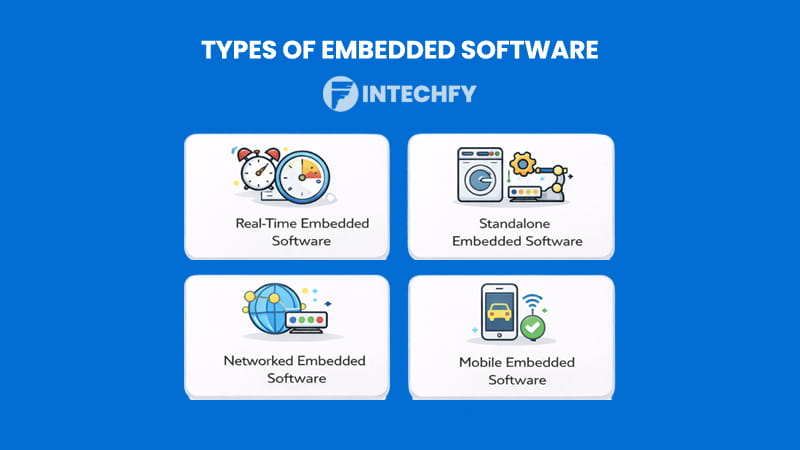
Not all embedded software behaves the same way. Different products demand different execution models, connectivity levels, and timing guarantees. Engineers typically classify device-level programs into several major categories based on how they operate and where they are deployed.
Choosing the right type early in development can prevent costly redesigns later. Each category below serves a distinct purpose and fits specific product scenarios.
Real-Time Embedded Software
Real-time embedded software is designed for systems that must respond within strict timing boundaries. Deterministic behavior is the defining feature. The system must react to inputs within a guaranteed time window.
This type is commonly used in automotive controllers, medical monitoring equipment, and industrial safety systems. For example, an anti-lock braking controller must process wheel speed data instantly to maintain vehicle stability.
Use this approach when timing precision directly affects safety or core functionality.
Standalone Embedded Software
Standalone designs operate independently without needing constant network connectivity or external system coordination. The device performs its dedicated task using local inputs and outputs.
Common examples include microwave ovens, digital watches, and simple home appliances. These systems prioritize reliability and low resource usage over connectivity features.
This approach works best when the product has a clearly defined function and minimal need for remote communication.
Networked Embedded Software
Networked systems are built to communicate with other devices or cloud platforms. They support wired or wireless protocols such as Ethernet, Wi-Fi, Bluetooth, or cellular links.
The rise of connected products has made this category increasingly important. Many smart home products rely heavily on embedded software in IoT environments to exchange data and receive updates remotely.
Choose this model when the device must share telemetry, receive remote commands, or participate in larger distributed systems.
Mobile Embedded Software
Mobile embedded systems operate in portable, battery-powered products. Energy efficiency and compact memory usage become top priorities in this category.
Wearable fitness trackers, handheld scanners, and portable medical devices often fall into this group. These products must balance performance with long battery life and responsive user interaction.
Developers typically use aggressive power management strategies to keep these systems running efficiently throughout the day.
Real-World Embedded Software Examples
The easiest way to grasp the impact of embedded software is to look at real products that depend on it every day. These systems rarely draw attention, yet they drive critical functionality across many industries.
In automotive engineering, the electronic control unit (ECU) manages engine timing, fuel injection, and emission controls. It processes sensor data continuously and adjusts parameters in real time to maintain performance and efficiency.
A smart thermostat provides another familiar example. It reads temperature data, compares it with user preferences, and automatically controls heating or cooling equipment. Many models also connect to mobile apps for remote monitoring.
Medical infusion pumps rely on tightly controlled logic to deliver precise medication doses. Timing accuracy and fault detection are essential here, since even small errors can create serious risks.
Industrial programmable logic controllers (PLCs) coordinate machinery on factory floors. They monitor sensors, trigger actuators, and maintain synchronized operations across complex production lines.
Wearable devices such as fitness bands and smartwatches also demonstrate how embedded software examples appear in compact consumer products. These devices continuously track motion, heart rate, and activity levels while operating on very limited battery capacity.
Embedded Software in Modern Technology
The influence of embedded software continues to expand as more products gain sensing, connectivity, and automation capabilities. What once powered simple control boards now supports entire ecosystems of intelligent devices across multiple industries.
From consumer electronics to heavy manufacturing, device-level intelligence enables products to operate with minimal human intervention while maintaining consistent performance.
in IoT
Connected devices depend heavily on embedded software in IoT deployments. Sensors collect environmental data, local processors analyze it, and network modules transmit results to cloud platforms or mobile apps.
Smart lighting systems, connected security cameras, and remote environmental monitors all follow this pattern. The software must balance networking tasks with strict memory and power constraints.
As IoT adoption grows, demand for efficient and secure device-level programming continues to rise.
in Robotics
Robotic systems rely on precise control loops to manage movement, perception, and decision-making. Embedded controllers handle motor coordination, sensor fusion, and safety monitoring in real time.
Industrial robots on assembly lines must react instantly to positional feedback. Service robots and autonomous machines require even more sophisticated control logic to navigate dynamic environments.
Reliable timing and efficient resource use remain critical in these applications.
in Industrial Automation
Factories increasingly depend on automated control systems to maintain productivity and consistency. Embedded controllers inside PLCs and industrial gateways coordinate sensors, conveyors, and robotic arms.
These environments demand extremely high uptime. Systems often run continuously for years, which places heavy emphasis on stability, fault recovery, and long-term maintainability.
Well-structured control code helps manufacturers reduce downtime and improve operational efficiency.
in Smart Devices
Consumer smart devices represent one of the fastest-growing areas. Smart TVs, home assistants, security systems, and connected appliances all rely on tightly optimized internal code.
Users expect instant response, low power consumption, and seamless connectivity. Meeting those expectations requires careful system design and efficient embedded software development practices.
As everyday products continue to gain intelligence, the importance of well-architected device-level software will only increase.
Benefits of Embedded Software
Modern devices demand precision, speed, and efficiency. That is where embedded software delivers the most value. By running directly inside dedicated hardware, it enables products to perform specialized tasks with minimal overhead and consistent reliability. Well-designed device-level code often becomes the difference between a product that feels polished and one that feels unreliable.
Key advantages include:
- High efficiency — Purpose-built control logic reduces unnecessary processing and keeps memory usage tight.
- Fast response times — Real-time behavior allows devices to react to inputs within milliseconds.
- Lower power consumption — Optimized execution helps battery-powered products run significantly longer, sometimes improving energy efficiency by 20–40% in well-tuned systems.
- Improved reliability — Focused functionality reduces the risk of unexpected failures during long-term operation.
- Compact system footprint — Smaller codebases fit easily into constrained microcontroller environments.
- Seamless hardware integration — Direct access to peripherals enables precise device control.
These benefits explain why manufacturers rely heavily on embedded software examples across automotive systems, medical devices, and smart consumer electronics. When performance and predictability matter, tightly integrated device code usually provides the most practical solution.
Embedded Software vs Related Technologies
The term embedded software often gets mixed up with firmware and application software. While they share some overlap, each serves a distinct role inside modern computing systems. Recognizing the differences helps developers choose the right approach for a given product.
Embedded Software vs Firmware vs Application Software
| Technology | Primary Role | Runs Where | When to Use |
|---|---|---|---|
| Embedded Software | Device control logic | Inside hardware | Dedicated devices |
| Firmware | Low-level hardware control | ROM/flash | Boot & hardware init |
| Application Software | User tasks | OS environment | End-user programs |
The table highlights how responsibility shifts across layers. Firmware usually handles the earliest startup routines and basic hardware configuration. It prepares the device so higher-level logic can run safely. Application programs sit at the opposite end of the stack. They operate inside full operating systems and interact directly with users.
Embedded software occupies the middle ground. It manages real-time behavior, hardware coordination, and system logic that must run continuously in the background. Many products actually contain all three layers working together. Clear separation between them improves maintainability and reduces the risk of system conflicts during updates or feature expansion.
Key Takeaways from the Comparison
The easiest way to avoid confusion is to think in layers. Firmware wakes the hardware and prepares the environment. Embedded control logic manages the device’s ongoing behavior. Application software focuses on user-facing features.
Each layer serves a specific purpose. Mixing responsibilities often leads to bloated code and harder debugging. When designing a product, engineers typically start by defining timing requirements, hardware complexity, and user interaction needs. That analysis quickly reveals which layer should handle each function.
For most dedicated electronic products, keeping these roles clearly separated leads to more stable and maintainable systems over time.
When You Should Use Embedded Software
Choosing embedded software makes sense when a product must perform a focused function with predictable timing and tight hardware integration. Not every project requires this level of specialization, but many modern devices depend on it to meet performance and reliability targets.
Signs You Need Embedded Software
Use this checklist as a quick guide:
- The device performs a dedicated, repeatable task
- Real-time response is important
- Hardware resources are limited
- Power efficiency is a priority
- The system must run continuously with minimal supervision
- Direct sensor or actuator control is required
If several of these conditions apply, a dedicated embedded software engineer would likely recommend a device-level approach.
When It May Be Overkill
There are cases where this approach adds unnecessary complexity. Products that mainly run user-driven applications on full operating systems often benefit more from traditional software stacks.
If the hardware is powerful, timing is flexible, and frequent feature updates are expected, a general-purpose platform may provide faster development and easier maintenance. Choosing the simplest architecture that meets requirements usually leads to better long-term results.
Common Challenges and Limitations
Despite its strengths, embedded software development comes with several practical hurdles. These challenges usually surface when a project moves beyond the prototype stage and starts facing real-world constraints.
The most common pressure points include:
- Memory constraints — Many microcontrollers offer very limited RAM and flash. Developers must constantly trim code size and manage data carefully to stay within tight boundaries.
- Debugging difficulty — Issues can appear intermittently and may be tied to timing or electrical behavior. Tools such as logic analyzers and in-circuit debuggers are often needed to pinpoint the root cause.
- Hardware coupling — Code is often tightly bound to a specific microcontroller. Moving to a new platform may require partial rewrites, which can slow product evolution.
- Update complexity — Delivering secure field updates requires careful planning, especially for connected devices deployed at scale.
- Security risks — Weak protection can expose network entry points or sensitive data. Secure boot, strong validation, and encrypted communication are essential safeguards.
Teams that anticipate these constraints early tend to avoid the most painful late-stage surprises.
Best Practices for Embedded Software Development
Strong embedded software development habits can significantly improve long-term stability and maintainability. Teams that invest in structure early usually spend far less time firefighting later.
Focus on these proven practices:
- Design with modular boundaries — Separate hardware access, communication logic, and application behavior into clean components. This keeps testing and updates manageable.
- Prioritize deterministic timing — Measure execution paths and validate worst-case response times, especially in real-time scenarios.
- Monitor memory usage continuously — Regular profiling helps catch overflows and fragmentation before they become production issues.
- Apply defensive programming — Watchdog timers, input validation, and fail-safe states help systems recover gracefully from unexpected conditions.
- Automate testing early — Unit tests and hardware-in-the-loop validation reduce regression risk before firmware reaches real devices.
- Document hardware assumptions clearly — Future maintainers depend on this clarity when the product evolves.
Consistent discipline in these areas often separates robust products from those that fail prematurely in the field.
Embedded Software vs Other Software Types
To place embedded software in the broader computer software ecosystem, it helps to compare it with other common software categories. Each type of software serves a different purpose and operates in a different layer of the computing stack.
- System Software — This category includes operating systems and core utilities that manage hardware resources for general-purpose computers. It provides the foundation on which applications run.
- Application Software — These are user-facing programs such as web browsers, office tools, and mobile apps. They focus on direct interaction and flexible functionality.
- Programming Software — Development tools like compilers, debuggers, and IDEs fall into this group. Their main role is to help developers create and test other software.
- Middleware — This layer acts as a bridge between applications and lower-level services, handling messaging, data exchange, and service coordination.
Each category operates at a different level of abstraction, while device-level control code remains tightly bound to dedicated hardware tasks.
Conclusion
Embedded systems have quietly become the backbone of modern electronics. From household appliances to industrial automation, tightly integrated device logic keeps products responsive, efficient, and dependable in real-world conditions.
Throughout this guide, you have seen how architecture, execution flow, and system constraints shape the way engineers design these solutions. The emphasis on timing precision, resource efficiency, and hardware awareness sets this field apart from general-purpose development.
As connected products continue to expand across homes, factories, and cities, the demand for well-structured device intelligence will only grow. Engineers who understand these fundamentals are better prepared to build reliable products that operate smoothly for years. Whether you are exploring the field or planning your next project, mastering these concepts provides a strong technical advantage.
FAQs About Embedded Software
What is embedded software in simple terms?
It is specialized code that runs inside dedicated hardware to control a specific device function automatically.
How is it different from firmware?
Firmware typically handles low-level startup and hardware initialization, while higher-level device logic manages ongoing behavior and real-time control.
Is it used in IoT devices?
Yes. Most connected sensors, smart home products, and industrial IoT nodes rely on device-level control code to process data and manage communication.
Is embedded development hard for beginners?
It can feel challenging at first due to hardware constraints and timing requirements, but structured learning and hands-on practice make it manageable.
What are common real-world use cases?
Automotive controllers, smart thermostats, medical devices, industrial PLCs, and wearable technology are all widely used examples.


